What AI Won't Do For Your Business (And What It Actually Will)
Published April 2026
If you've been following this series, you're past the "AI isn't for me" stage. You know it's relevant to your business. You know you're probably already using it in ways you didn't realize. And you're starting to get more intentional about it.
Good. Now let's have the conversation that most AI content skips: where this stuff actually falls short.
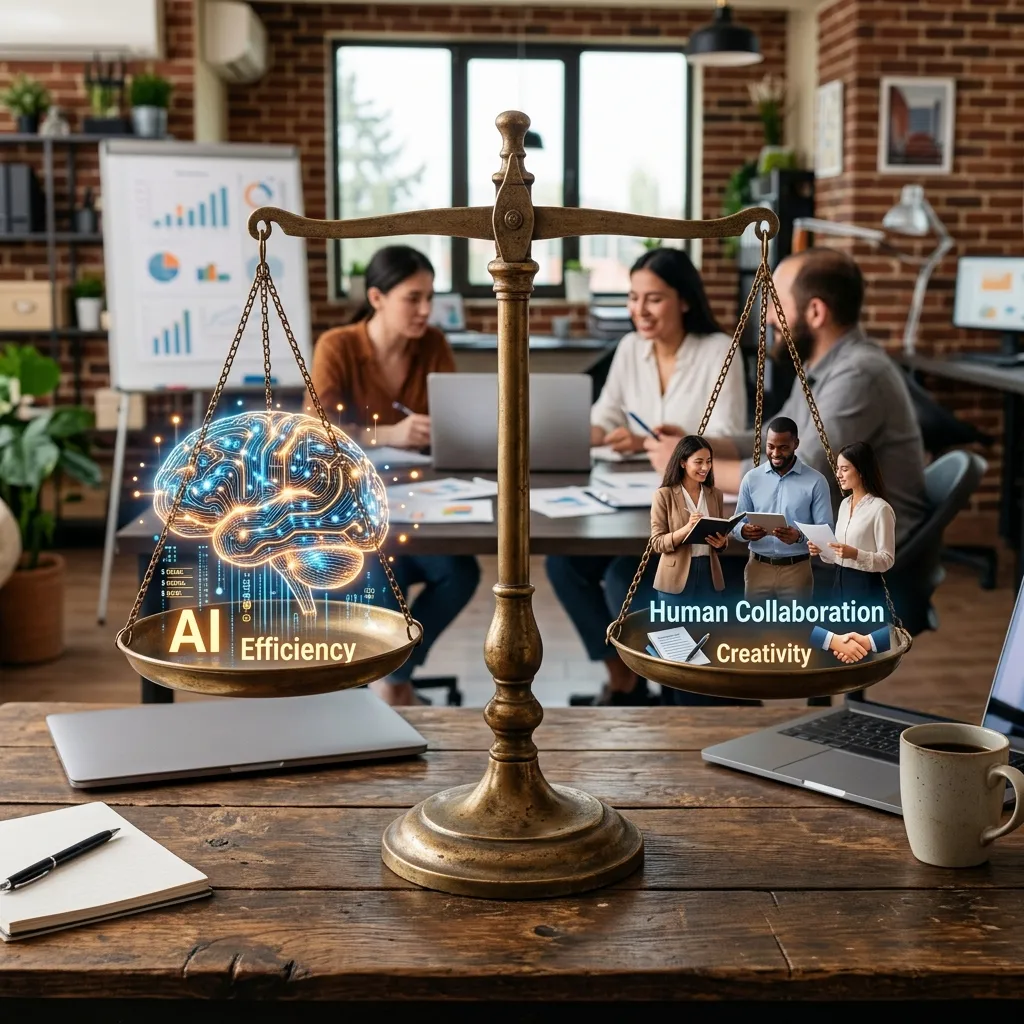
Because here's the thing — AI is genuinely useful. But it's not magic, and it's not a replacement for your brain. The businesses that get the most out of it are the ones that understand what it's good at and what it's bad at, so they can point it at the right problems and keep a human in the loop for everything else.
This post is the honest middle ground between the hype and the fear. No breathless promises, no doomsday predictions. Just a clear-eyed look at what AI won't do for your business — and what it actually will.
What AI Won't Do
Let's start with the uncomfortable stuff. These aren't edge cases or theoretical risks — they're real limitations that affect how you should use AI in your business right now.
It won't always get the facts right.
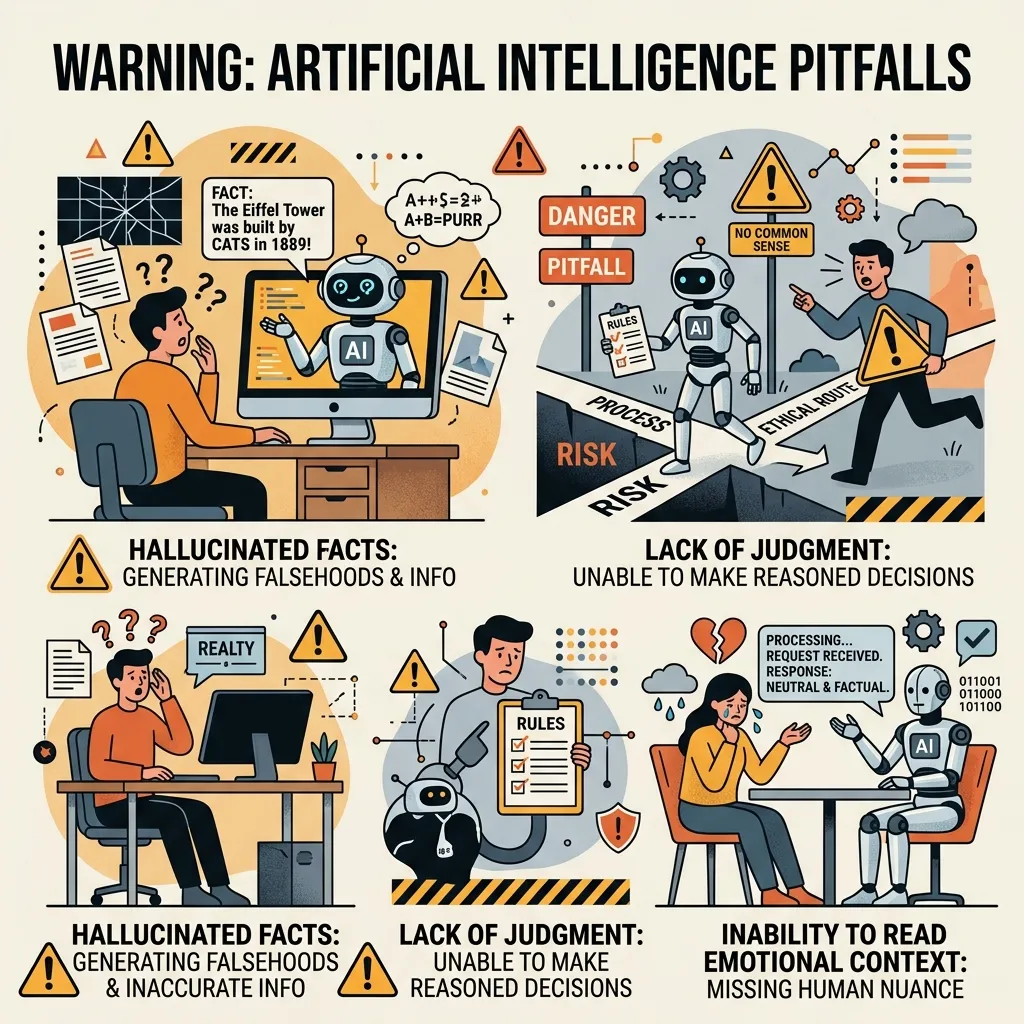
This is the big one. AI models — even the best ones — sometimes generate information that sounds confident and authoritative but is completely wrong. The industry calls this "hallucinating," and it's not a rare glitch. Research has found that even top-tier models can produce inaccurate outputs anywhere from under 1% of the time on simple, grounded tasks to over 30% on complex or open-ended questions.¹ A Deloitte survey found that 38% of business executives reported making incorrect decisions based on hallucinated AI content.²
In real-world terms: AI might cite a source that doesn't exist, invent a statistic, or confidently state something that's just wrong. A law firm was sanctioned after filing court documents with AI-generated case citations that were entirely fabricated.³ Air Canada had to honor an AI chatbot's incorrect promise of a discount it never intended to offer.³
The takeaway isn't "don't use AI." It's "don't blindly trust AI." Anything AI produces that involves facts, figures, legal claims, or client-facing information needs a human set of eyes before it goes anywhere.
It won't replace your judgment.
AI can process information and identify patterns faster than any human. But it can't weigh that information against your experience, your knowledge of your customers, your gut sense of what's right for your business, or the messy human context that drives real decisions.
Research from Harvard Business School found that AI can't substitute for human judgment or experience — and that the entrepreneurs who got the most value from AI were the ones who already had enough business knowledge to evaluate whether the AI's suggestions were actually good.⁴ The low-performing entrepreneurs in the study were more likely to accept generic AI advice at face value, sometimes to their detriment.
AI is an excellent advisor. It's a terrible decision-maker. The moment you stop asking "does this make sense?" and start just doing whatever the AI suggests, you've given up the one thing it can't replicate.
It won't understand your customers the way you do.
AI can analyze customer data, segment audiences, predict purchasing behavior, and personalize marketing at scale. That's valuable. But it can't read the room. It can't tell that a long-time customer's curt email means they're frustrated, not angry. It can't navigate the nuance of a sensitive negotiation, pick up on body language in a meeting, or know that Mrs. Rodriguez always orders extra napkins and will be annoyed if you forget.
Relationships are built on empathy, context, and the kind of human understanding that comes from actually caring about the person on the other end. AI can support those relationships by handling routine touchpoints efficiently, but it can't be the relationship. For small businesses especially — where personal connection is often the competitive advantage — that distinction matters a lot.
It won't do your creative thinking.
AI can generate content. A lot of it, quickly. But it generates by remixing patterns from its training data — it doesn't have ideas the way you do. It can't conceive a new business strategy, identify an opportunity nobody else has seen, or bring the kind of original perspective that comes from being deeply embedded in your industry and community.
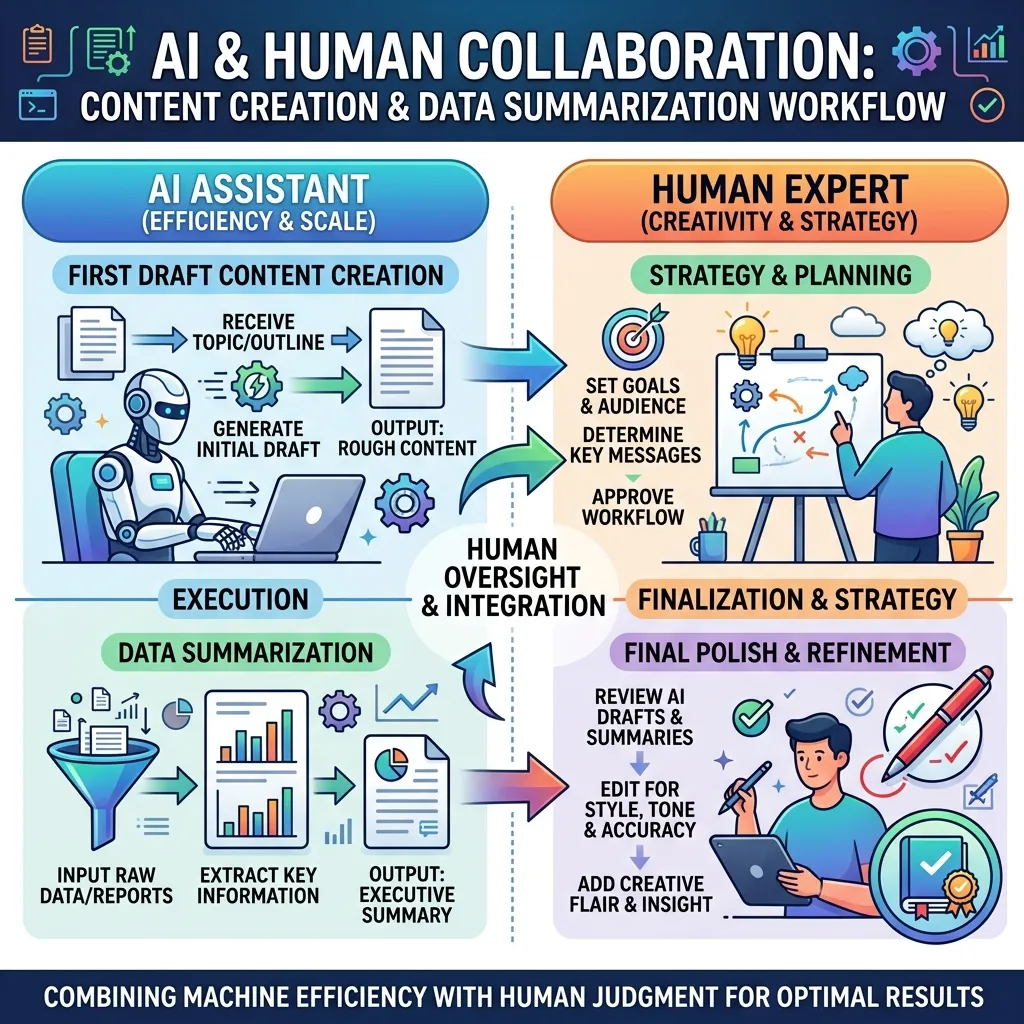
Think of AI as an extremely fast first-draft machine. It's great at getting you from a blank page to a starting point. But the spark — the insight, the angle, the thing that makes your business yours — that still has to come from you.
It won't keep itself in check.
AI doesn't know what it doesn't know. It won't flag when it's out of its depth. It won't tell you "I'm not confident about this answer" or "you should double-check this with a professional." It will produce output with the same polished confidence whether it's spot-on or completely off-base.
This means the responsibility for quality control always sits with you. AI is a tool, and like any tool, it does what you point it at. If you point it at something it's not suited for and don't check the output, the mistakes are yours.
What AI Actually Will Do
Now for the other side. Because despite all of the above, AI is genuinely transforming how small businesses operate — not in some theoretical future, but right now. Here's where it actually delivers.
It will save you real, measurable time.
This is the most consistent and immediate benefit. As we covered earlier in this series, small business employees using AI save an average of 5.6 hours per week.⁵ That's not a projection — it's what's already happening. For tasks like drafting emails, writing social media content, summarizing documents, categorizing expenses, and generating first drafts of proposals, AI cuts the time dramatically. Not by 10 or 15 percent — often by 50% or more.
For a small business owner who's always running out of hours in the day, that's not a nice-to-have. It's a real shift in what's possible.
It will handle the work you keep putting off.
Every business has those tasks that are important but never urgent enough to get done — updating the website FAQ, responding to every online review, writing product descriptions for the new catalog, drafting a follow-up sequence for leads that went cold. AI is perfect for this kind of work. It's not going to produce a masterpiece, but it'll produce a solid draft you can clean up in a fraction of the time it would take to start from scratch. That backlog of "I'll get to it eventually" tasks? AI can actually make a dent.
It will help you look more polished and professional.
One of the underrated benefits of AI for small businesses is the quality bump in everyday communications. A quick pass through an AI tool can turn a rushed, typo-filled email into something polished and professional. It can elevate a bland product description into something that actually sells. It can turn your rough notes from a meeting into a clean summary you'd be comfortable sharing with a client.
You don't need to hire a copywriter for every email or a designer for every social post. AI won't replace those professionals for high-stakes work, but for the day-to-day stuff, it raises your baseline quality considerably.
It will let you compete above your weight class.
This is the strategic argument for AI, and it's a big one. Small businesses have always been at a disadvantage when it comes to resources — less staff, less budget, less time. AI narrows that gap. It lets a three-person team produce the kind of content output, customer response time, and data analysis that used to require a much larger operation.
You're not going to out-spend a big competitor. But with AI handling your repetitive work, you can out-hustle them — responding faster, publishing more consistently, personalizing more effectively, and freeing up your own time to focus on the things that actually require your expertise.
It will keep getting better.
This might be the most important point of all. The AI tools available today are the worst they'll ever be. Every model update improves accuracy, speed, and capability. Features that feel clunky or limited right now will be smoother in six months and dramatically better in a year. The businesses that start building AI into their workflows now aren't just getting today's benefits — they're building the muscle memory and habits that will compound as the technology improves.
The Rule of Thumb
If you take one thing from this post, make it this: AI is a spectacular assistant and a terrible boss.
Use it to draft, research, brainstorm, summarize, automate, and accelerate. Don't use it to make decisions, replace relationships, or produce anything client-facing without reviewing it yourself.
The pattern that works is simple: AI does the first 80% of the work (the slow, tedious, blank-page part), and you do the last 20% (the judgment, the polish, the "does this actually make sense for my business" check). That's where the real time savings come from — not from removing humans from the process, but from removing the parts of the process that humans are slowest at.
The Bottom Line
AI hype tells you it's going to revolutionize everything. AI fear tells you it's going to ruin everything. The truth is predictably somewhere in between, and it's a lot more useful than either narrative suggests.
AI is a tool with real limitations — it hallucinates, it lacks judgment, it can't do your creative thinking, and it won't manage itself. But within its sweet spot — speed, scale, first drafts, automation, pattern recognition — it's the most powerful productivity tool most small businesses have ever had access to.
The businesses that thrive with AI won't be the ones that hand everything over to it. They'll be the ones that know exactly where to use it and where to step in. That combination of AI efficiency and human judgment isn't just the safe approach — it's the one that actually gets results.
This is Part 3 of the AI Without the BS series. Up next: The Small Business Owner's AI Starter Kit: 5 Things You Can Do This Week — the action plan you've been waiting for.
Need help figuring out the right balance of AI and human effort for your business? We can help you build that playbook. [Get in touch for a consultation.]
Sources:
AllAboutAI / Vectara, "AI Hallucination Report 2025" — hallucination rate data across major models (2025)
Deloitte, cited in "Understanding the Risks AI Hallucinations Create for Businesses" — National Law Review (2025)
IntuitionLabs, "AI Hallucinations in Business: Causes and Prevention" (2026) — Air Canada and legal citation examples
Harvard Business School / Institute for Business in Global Society, "AI Won't Make the Call: Why Human Judgment Still Drives Innovation" (September 2025)
Business.com / Dialog, "2026 Small Business AI Outlook Report" (January 2026)