
Why 82% of Small Businesses Think AI Isn't For Them (And Why They're Wrong)
Published April 2026

Here's a stat that should make every small business owner pause: according to the SBA Office of Advocacy, 82% of businesses with fewer than five employees say AI just isn't applicable to their business.¹ Not that it's too expensive. Not that they tried it and it didn't work. They've decided — before ever really looking into it — that it's simply not for them.
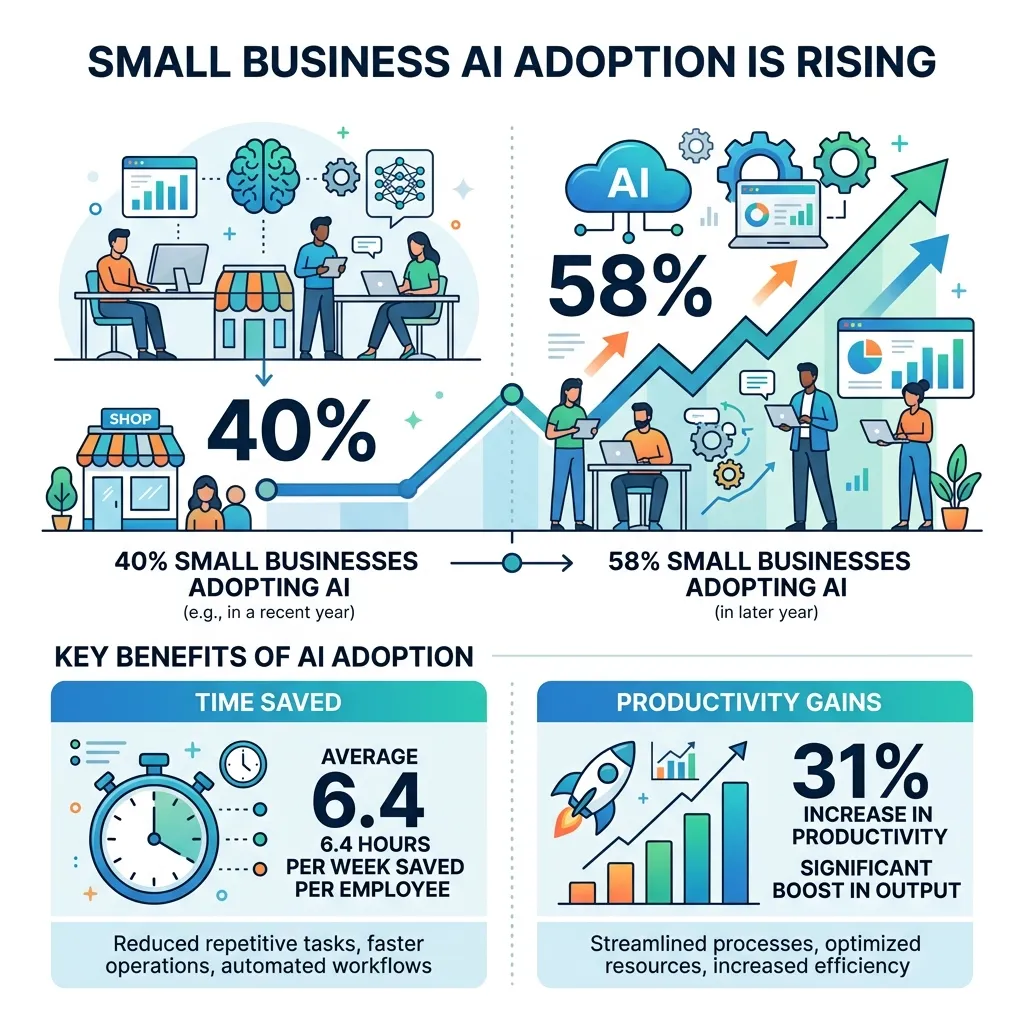
Meanwhile, adoption tells a completely different story. A U.S. Chamber of Commerce study found that 58% of small businesses are already using generative AI — up from 40% just a year earlier.² And in a separate Goldman Sachs survey, 81% of small business owners said AI would be essential to their business within five years.³
So a huge chunk of small business owners believe AI isn't relevant to them, even as the majority of their peers are already using it and most of the rest expect to soon. Something doesn't add up.
This isn't a story about small business owners being behind the times. It's a story about a technology that has a serious branding problem — and an information gap that's costing real businesses real money.
The "It's Not For Me" Myth
Let's be honest about why so many business owners have mentally filed AI under "not my problem." When most people hear "artificial intelligence," their brain conjures images of self-driving cars, humanoid robots, or some Silicon Valley startup burning through $200 million in venture capital. None of that feels relevant when you're running a landscaping company or managing a dental practice.
And that mental image isn't their fault — it's how AI has been marketed. The tech industry has spent years talking about AI in the most grandiose, inaccessible terms possible, and media coverage has mostly followed suit. So when a plumber in Boise hears "AI is transforming business," their completely reasonable response is, "Cool, but I need to schedule three estimates and write a follow-up email before lunch."
Here's the thing, though — AI can actually help with both of those tasks. And it can probably do it faster than they can.
The barriers small business owners cite aren't really about rejection — they're about confusion. In a Goldman Sachs survey, 45% said they lack the technical expertise to use AI, and 47% said it's hard to even pick the right tools. But here's the telling part: in that same survey, 88% said they want more training and support to implement it successfully.³ These aren't people who've evaluated AI and walked away. They're people who never got past the front door because nobody showed them where it was.
And for the smallest businesses — the ones with fewer than five employees — the dominant reason for not using AI isn't cost, complexity, or privacy concerns. It's that simple belief that it doesn't apply to them.¹ Researchers at the SBA suspect this is an education issue, not an applicability one. Because when you actually look at what AI can do in 2026, it's hard to find a business it can't help.
What AI Actually Looks Like in a Small Business
Part of the disconnect is that people imagine AI as some massive, expensive system overhaul — like they'd need to hire a data scientist and rewire their entire operation. In reality, most small business AI usage looks incredibly mundane. And that's the point.
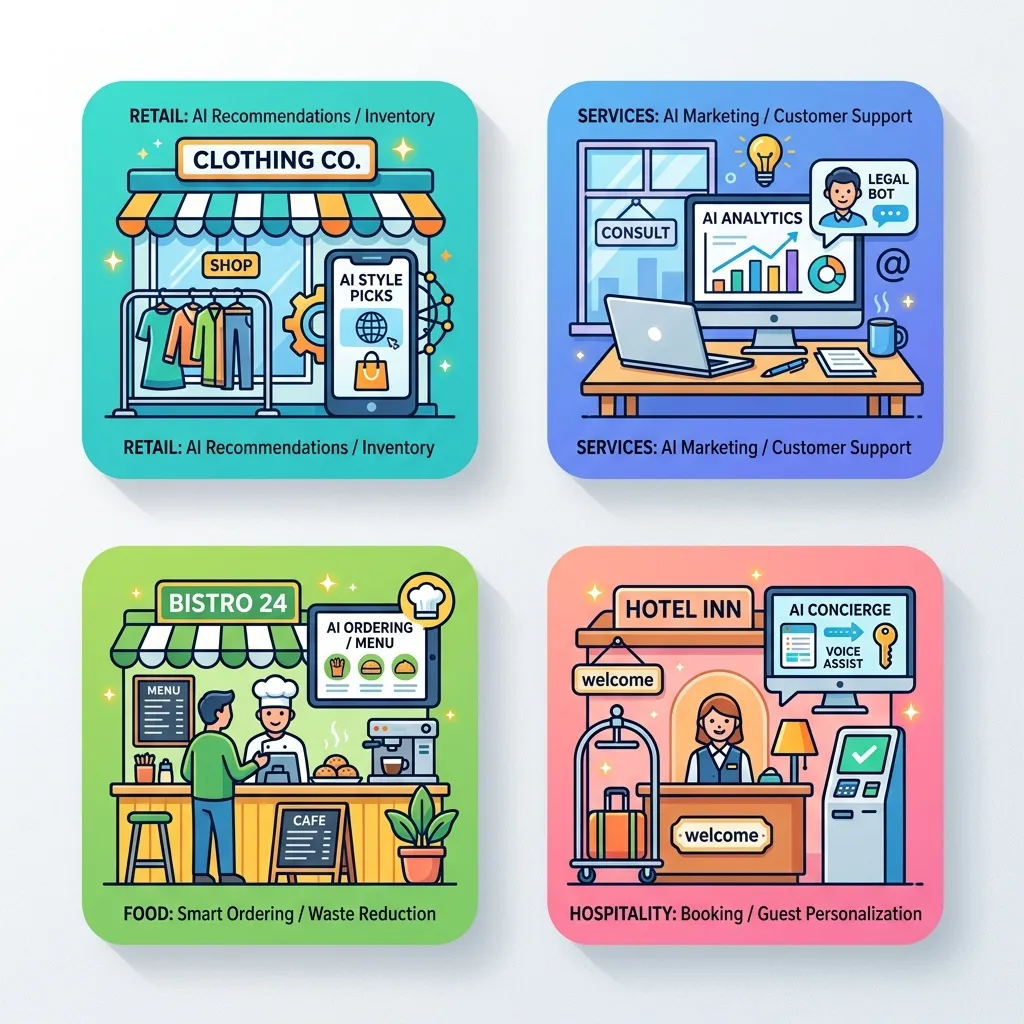
Here's what AI actually looks like across different types of businesses:
If you run a service-based business — think consulting, landscaping, cleaning, marketing — AI can draft your proposals, write follow-up emails to clients, generate social media posts, and summarize meeting notes. You know that client email you've been putting off because you're not sure how to word it? That's a 30-second task with AI.
If you're in retail or e-commerce, AI can write product descriptions (all 200 of them, if you need it to), help with inventory forecasting, handle first-line customer service questions through chatbots, and generate ad copy variations so you're not staring at a blank screen trying to be clever about a seasonal sale.
If you're in the trades — plumbing, electrical, HVAC, construction — AI can help you draft estimates, manage and respond to online reviews (which directly affect whether new customers call you), create FAQ content for your website, and even convert your voice notes from a job site into organized written documentation.
If you run a professional services firm — accounting, legal, real estate, financial planning — AI can summarize lengthy documents, draft routine client communications, assist with research, and help analyze data patterns in your business. That 40-page contract you need to review? AI can pull out the key points in seconds so you know where to focus your attention.
If you're in food or hospitality, AI can write menu descriptions, handle reservation and inquiry responses, manage your social media content calendar, and draft thoughtful replies to online reviews — which, if you've ever stared down a one-star review at 11 PM, you know is worth its weight in gold.
None of this requires a computer science degree. None of it requires an expensive software overhaul. Most of it can be done with tools that are either free or cost less than your monthly coffee budget.
The Numbers Don't Lie
If the use cases above sound nice but theoretical, let's talk about what's actually happening in the businesses that have taken the plunge.
According to a 2026 report from Business.com, small business employees using AI tools save an average of 5.6 hours per week. For managers, that number jumps to 7.2 hours.⁴ Let that sink in for a second — we're talking about getting nearly a full workday back every single week.
The SBE Council found that 73% of small businesses using AI say it's been important to their competitiveness and growth over the past year.⁵ And it's not just the early adopters seeing results — a Thryv survey showed that AI adoption among small businesses surged 41% between 2024 and 2025, with usage especially strong among companies with 10 to 100 employees.⁶
Here's another data point worth chewing on: according to the U.S. Chamber of Commerce, 82% of small businesses that use AI were able to grow their workforce over the past year.⁷ So much for the "AI is going to replace all the jobs" narrative — at least at the small business level, it appears to be doing the opposite.
And the gap between small businesses and large enterprises? It's closing fast. The SBA notes that the AI adoption divide between small and large firms is shrinking far more quickly than previous technology cycles. When broadband was nearly universal among large companies in 2004, only 48% of small businesses even had high-speed internet.¹ AI isn't following that pattern — small businesses are catching up in years, not decades.
The Federal Reserve Bank of St. Louis puts an even finer point on it: generative AI adoption has outpaced the adoption rates of both the personal computer and the internet at the same point in their respective timelines. Three years after ChatGPT's release, over 54% of U.S. adults were using generative AI — compared to just under 20% who had a personal computer three years after the IBM PC launched.⁸
This isn't a slow-moving trend you have time to wait out. It's already here, and it's moving fast.
So What's Actually Holding You Back?
If you've read this far and you're thinking, "Okay, maybe it does apply to me, but..." — let's address the buts.
"I'm not technical enough." You don't need to be. The most widely used AI tools — ChatGPT, Google's Gemini, Microsoft Copilot, Claude — are conversational. You type what you need in plain English, and they respond. If you can write a text message, you can use generative AI. The learning curve is genuinely measured in minutes, not months.
"There are too many tools and I don't know where to start." That's fair, and it's one of the most commonly cited barriers. But you don't need to evaluate the entire AI landscape before you start. Pick one pain point in your business — the task you dread most or the one that eats up the most time — and look for a tool that addresses it. Start with one thing. You can expand later.
"I'm worried about privacy and data security." This is a legitimate concern, and you should take it seriously. The short version: don't paste sensitive customer data, financial records, or proprietary information into free AI tools. Many paid tools offer data privacy protections and won't use your inputs to train their models. Read the terms of service, and when in doubt, keep sensitive data out. But don't let this concern stop you from using AI for the dozens of tasks that don't involve sensitive information at all — like drafting marketing copy, brainstorming ideas, or summarizing a long article.
"I don't have time to learn something new." This is the most ironic barrier on the list, because the entire point of these tools is to give you time back. That 5.6 hours per week figure⁴ didn't come from people who spent weeks in training. It came from people who started using a tool and immediately saw the benefit. The time you spend learning is paid back almost instantly.
"I tried it once and the output wasn't great." This one's common and completely understandable. AI tools aren't magic — they're only as good as what you ask them. A vague prompt gets a vague answer. A specific, detailed prompt gets something genuinely useful. There's a bit of a skill to it (and we'll cover that in detail later in this series), but the basics are simple: tell it exactly what you want, who it's for, and what tone you're going for. The difference is night and day.
Where to Start (Without Overthinking It)
We're not going to turn this into a step-by-step tutorial — that's coming later in the AI Without the BS series. But if this article has shifted your thinking even a little, here's the simplest possible next step:
Think about one task you do every week that's repetitive, tedious, or just takes longer than it should. Writing emails. Creating social media posts. Summarizing notes. Drafting proposals. Responding to reviews. Pick one.
Then open ChatGPT (it's free), type something like "Help me write a professional follow-up email to a client I gave an estimate to last week," and see what comes back. Edit it, adjust it, make it yours — but notice how much faster you got to a solid starting point than you would have staring at a blank screen.
That's it. That's the whole starting line. No software to install, no subscription to buy, no 47-step implementation plan. Just one task, one tool, and five minutes.
The Bottom Line
That 82% stat isn't a reflection of AI being irrelevant to small businesses — it's a reflection of how badly the tech world has communicated what AI actually is and does. Somewhere along the way, "artificial intelligence" became synonymous with billion-dollar moonshots instead of "the thing that can write your Tuesday email newsletter in four minutes."
The small business owners who figure this out now aren't just going to save a little time here and there. At 7.2 hours saved per week, that's over 370 hours a year.⁴ If your time is worth $50 an hour — and for most business owners, it's worth a lot more — that's north of $18,500 in reclaimed value annually. And that's per employee, not total. For a business with a few team members, the math gets even more compelling. Research from Lucid Financials found that generative AI is returning an average of $3.70 for every dollar invested, and a quarter of businesses using AI are saving more than $20,000 per year.⁹
Those numbers aren't coming from Fortune 500 companies with dedicated AI departments. They're coming from small businesses that decided to stop waiting and start experimenting.
And the ones who keep saying "it's not for me"? They'll come around eventually. But by then, their competitors will already have a head start.
This is Part 1 of the AI Without the BS series. Next up: You're Probably Already Using AI — Here's How to Actually Get Good At It.
Not sure where AI fits into your business? That's the kind of thing we help figure out. [Get in touch for a consultation.]
Sources:
SBA Office of Advocacy, "AI in Business: Small Firms Closing In" (September 2025)
U.S. Chamber of Commerce, "Empowering Small Business: The Impact of Technology on U.S. Small Business" (2025)
Goldman Sachs 10,000 Small Businesses, "Small Business Owners Plan to Grow, Bullish on AI Productivity" (October 2025)
Business.com / Dialog, "2026 Small Business AI Outlook Report" (January 2026)
SBE Council, "Small Businesses Confident About 2025 Year-End Performance" (October 2025)
Thryv, "AI Adoption Among Small Businesses Surges 41% in 2025" (2025)
Fortune, "Fewer than 1 in 5 Small Businesses Are Good at Actually Integrating AI" (March 2026)
Federal Reserve Bank of St. Louis, "The State of Generative AI Adoption in 2025" (November 2025)
Lucid Financials, "AI ROI Metrics for Small Businesses" (2025)